Fused Deposition Modeling for Jigs, Fixtures, and Shop Floor Tools
Production work often depends on small tools that never become part of the final product. Jigs hold parts in position. Fixtures keep assemblies aligned. Gauges, guides, trays, and protective covers make repetitive tasks easier. Fused deposition modeling gives manufacturers a practical way to produce many of these tools without machining every one from metal.
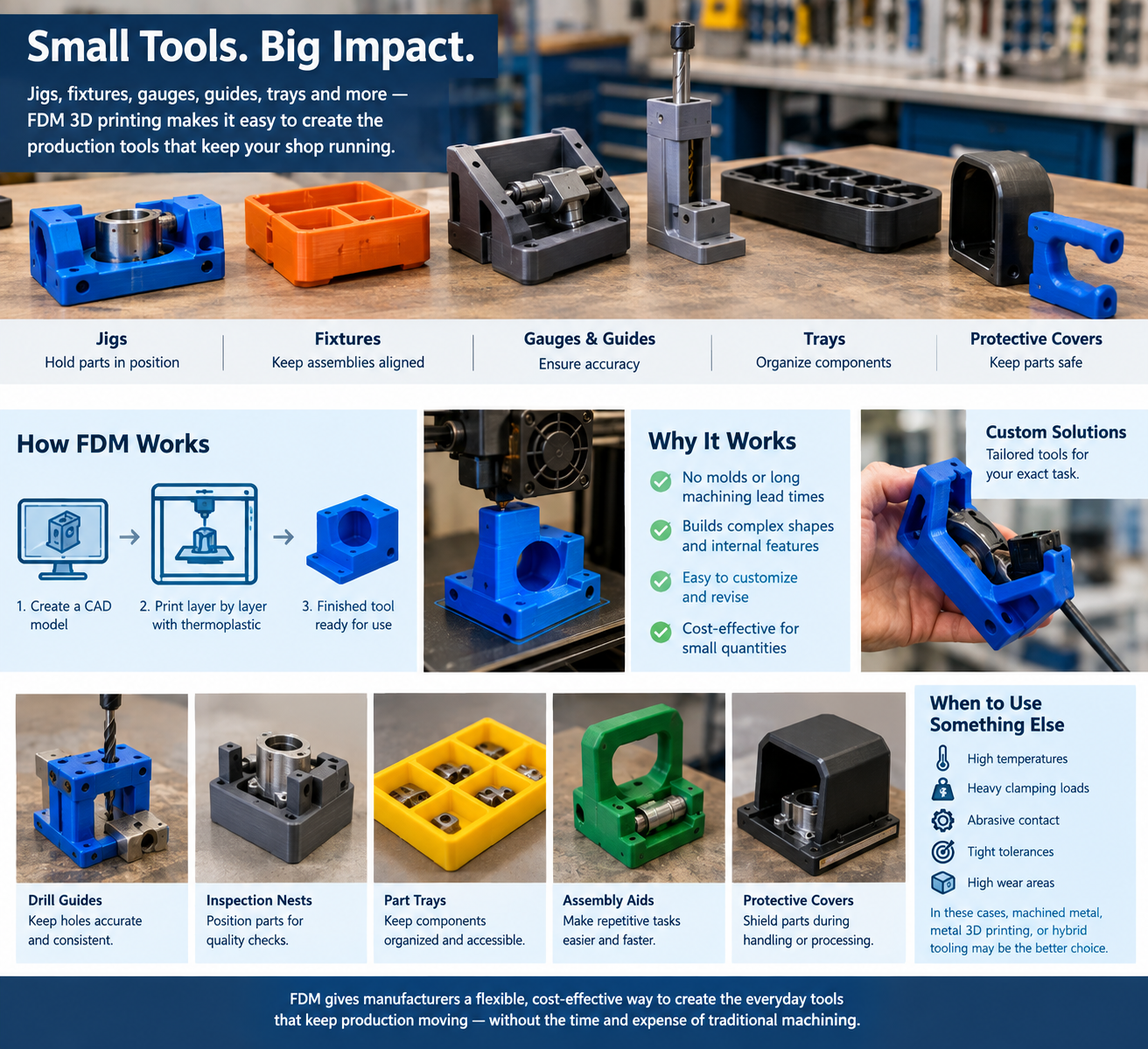
Table of Contents
- 1 Using Fused Deposition Modeling for Everyday Shop Floor Tools
- 2 How Fused Deposition Modeling Works for Jigs and Fixtures
- 3 Fused Deposition Modeling for Custom Tooling on the Shop Floor
- 4 Making Low-Cost Jigs and Fixtures With Fused Deposition Modeling
- 5 Where Fused Deposition Modeling Fits Into Production Tooling
- 6 Building Shop Aids and Fixtures With Fused Deposition Modeling
- 7 Fused Deposition Modeling for Quick-Change Manufacturing Tools
Using Fused Deposition Modeling for Everyday Shop Floor Tools
Many shop floor tools do not need the strength or service life of hardened steel. A positioning block, inspection nest, drill guide body, or assembly aid may only need enough stiffness to hold a component consistently during a specific operation.
That makes fused deposition modeling 3D printing useful for everyday production support. A CAD model can be turned into a physical tool without creating molds or setting up a lengthy machining job. Industrial 3D printing also gives designers freedom to add handles, labels, contoured surfaces, or pockets that match the part being handled.
How Fused Deposition Modeling Works for Jigs and Fixtures
FDM builds parts by depositing thermoplastic material in successive layers. The printer follows the digital model, creating the jig or fixture from the bottom upward. Because material is added rather than cut away, hollow areas, internal ribs, and unusual contours can be built into the design without extra machining steps.
The process works especially well when a fixture needs to follow an irregular component. Instead of machining a complex pocket from a solid block, the printed tool can be shaped directly around the workpiece. That can reduce material use and make the finished tool easier to handle on the shop floor.
Fused Deposition Modeling for Custom Tooling on the Shop Floor
Production tooling often becomes very specific. One station may need a guide that holds a connector at a certain angle. Another may need a nest that prevents a finished surface from touching a metal table. Custom tools like these can be simple, but conventional fabrication still takes time.
Additive manufacture makes those one-off designs easier to justify. If operators identify a problem, a fixture can be designed around the exact task rather than adapted from something already on hand. Huntsville additive manufacture applications can include this type of support tooling alongside more complex aerospace, industrial, or engineering work.
Making Low-Cost Jigs and Fixtures With Fused Deposition Modeling
A machined fixture may be a poor investment if the production run is short or the product design is still changing. FDM offers another route. The tooling can be produced without dedicated molds, and revisions usually begin with changing the digital model rather than rebuilding the manufacturing setup.
That is useful during pilot production and process development. If a locating surface needs to move or an operator needs more clearance around a clamp, the model can be updated and another version produced. Rapid manufacturing 3D printing makes these small iterations easier to carry into actual production work.
Where Fused Deposition Modeling Fits Into Production Tooling
FDM is not a replacement for every traditional fixture. High temperatures, heavy clamping loads, abrasive contact, tight wear surfaces, or demanding dimensional requirements may call for machined metal instead. The expected working environment should drive the material decision.
Hybrid tooling can also make sense. A printed fixture body may use metal bushings, threaded inserts, pins, or wear plates in areas that see repeated contact. Metal 3D printing can cover another range of applications where strength, heat resistance, or complex metal geometry is required. Processes such as powder bed fusion 3D printing serve very different needs from polymer FDM.
Building Shop Aids and Fixtures With Fused Deposition Modeling
Some of the best FDM applications are not complicated at all. Tool holders, part trays, protective covers, ergonomic grips, drill templates, checking fixtures, and assembly nests can remove small frustrations from repetitive production work.
A printed shop aid can also be made lighter than a comparable solid metal fixture. Internal ribs and hollow sections can provide the needed stiffness without creating unnecessary weight. That matters for tools that operators lift, reposition, or carry between stations throughout a shift.
Fused Deposition Modeling for Quick-Change Manufacturing Tools
Short production runs and frequent product revisions create a challenge for fixed tooling. A fixture built around one version of a component may become obsolete after a seemingly minor design change. FDM makes it easier to revise tooling along with the part.
For companies working beyond polymer shop tools, services related to metal 3D printing Huntsville AL may become relevant as production requirements change. Additive Manufacturing Engineering is one specialized provider that works with metal additive manufacturing, design optimization, prototyping and production, structural CAD, complex structures, and metallurgy-related analysis. Its engineering support can help when a project moves from basic printed tooling into more demanding metal additive applications.
Fused deposition modeling makes the most sense where tooling needs to be customized, revised quickly, or produced in small quantities. It gives manufacturers another option between improvised shop aids and fully machined fixtures. Used for the right tasks, it can make everyday production tooling easier to create, adjust, and replace without adding more complexity than the job requires.