How Facility Managers Can Reduce Commercial Heating Waste
Commercial heating efficiency is not only about installing newer equipment. It is about making sure the entire building, including controls, airflow, insulation, schedules, and maintenance practices, works together. When problems exceed the scope of routine in-house checks, working with a commercial heating company near you can help identify issues that affect comfort, reliability, and operating costs.
A practical approach starts with measuring what is happening now. Review utility use, occupant complaints, equipment runtime, and repair history before making major changes. Small corrections, such as updating schedules or repairing a damaged door sweep, can sometimes reduce unnecessary heating runtime while preserving comfortable indoor conditions.
Table of Contents
- 1 Why Heating Waste Matters
- 2 Start With A Building Check
- 3 Review Controls And Operating Schedules
- 4 Protect Airflow And Heat Transfer
- 5 Make Maintenance More Predictive
- 6 Consider Equipment Upgrades Carefully
- 7 Reduce Heat Loss Around The Building
- 8 Build A Practical Action Plan
- 9 Common Questions
- 10 Conclusion
Why Heating Waste Matters
Heating can represent a substantial operating expense for offices, schools, warehouses, retail locations, and other commercial properties. Waste often results from equipment running during unoccupied hours, inaccurate sensor readings, restricted airflow, duct leakage, failing components, or heat escaping through exterior openings. Comfort and efficiency should support one another when equipment is correctly sized, maintained, and controlled.
Facility managers should also keep current energy expectations in view. Commercial building energy efficiency standards continue to emphasize practical, cost-justified performance improvements, while many organizations are also setting internal goals for lower energy use and operational emissions.
Start With A Building Check
Before approving a major equipment purchase, evaluate the building itself. A replacement system may not resolve cold rooms caused by air leaks, poor insulation, inaccurate thermostat locations, or uneven heat distribution. Keep a room-by-room comfort log for several weeks, including the time, outdoor conditions, occupancy, and any observed issues. Patterns are often more useful than a single complaint.
Areas To Review
- Rooms that are consistently too warm or too cold.
- Doors, windows, loading areas, and vestibules that admit outside air.
- Insulation around roofs, walls, pipes, and accessible ducts.
- Equipment age, repair frequency, and service records.
- Heating use during occupied and unoccupied periods.
- Thermostat placement, calibration, and sensor accuracy.
Review Controls And Operating Schedules
Controls often offer the fastest path to reducing needless runtime. Buildings may continue heating empty spaces because schedules were never updated after a tenant change, a revised shift, a holiday closure, or an altered school calendar. Set operating schedules based on actual occupancy, use appropriate nighttime and weekend setbacks, and confirm that each zone responds to actual room conditions.
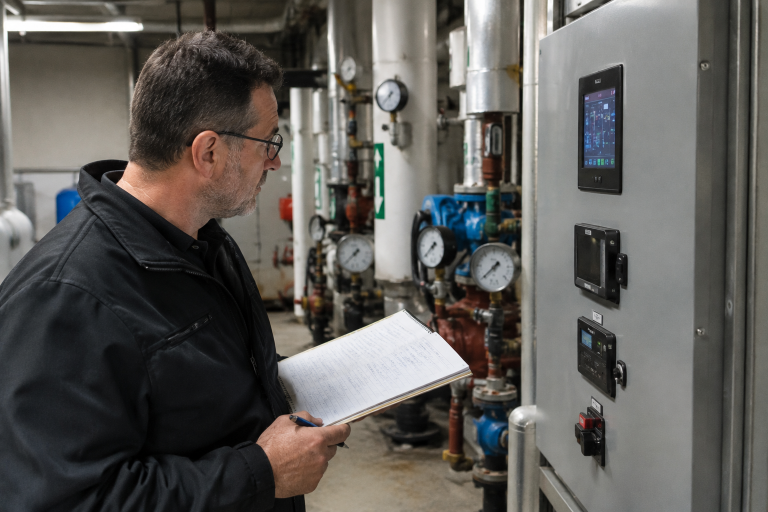
For example, an office that opens at 8:00 a.m. may not need every zone at full comfort settings at 4:00 a.m. A properly planned warm-up period can prepare occupied areas before staff arrive without heating the entire building for several extra hours. Review alarms as well, since recurring sensor or communication alerts can become larger comfort problems if ignored.
Protect Airflow And Heat Transfer
A heating system cannot deliver dependable comfort if air cannot circulate as designed. Dirty filters, blocked supply or return grilles, damaged ducts, improperly positioned dampers, and unbalanced zones can cause equipment to run longer without addressing the underlying problem. Replace filters based on building conditions and manufacturer recommendations, not solely by a fixed calendar date.
Simple Airflow Checks
- Keep furniture, stored materials, and displays away from grilles.
- Inspect accessible ductwork for visible gaps, loose insulation, or damage.
- Note rooms with weak airflow or repeated temperature complaints.
- Confirm that renovations have not blocked vents or altered air paths.
- Check that accessible dampers move as intended.
Testing and balancing may be needed when airflow problems persist. Facility staff should avoid opening sealed equipment or performing work involving fuel, electrical components, refrigerant, or combustion systems unless they are qualified and authorized to do so.
Make Maintenance More Predictive
Maintenance should do more than address breakdowns. Seasonal inspections can identify worn belts, loose connections, failing sensors, unusual sounds, pump or fan concerns, and control problems before they cause a shutdown. Document readings, repairs, and recommendations in one location. Repeated faults in the same zone may indicate a larger control, distribution, or design issue.
- Review repair records from the previous heating season.
- Inspect equipment before the coldest weather arrives.
- Test safety controls and normal operating sequences.
- Check accessible fans, belts, pumps, valves, and connections.
- Schedule follow-up repairs before minor defects become emergencies.
Consider Equipment Upgrades Carefully
Equipment age alone should not determine replacement. Consider current building use, occupancy hours, utility costs, available fuel sources, maintenance access, and future renovation plans. Ask whether the existing system is properly sized for today’s load and whether controls, ductwork, insulation, or distribution issues should be corrected first.
Compare total ownership costs rather than purchase price alone. Include installation requirements, expected energy use, maintenance needs, parts availability, downtime during installation, expected service life, and how the new equipment will integrate with existing ductwork, piping, and electrical service.
Reduce Heat Loss Around The Building
Even efficient heating equipment must work harder when heat escapes through the building envelope. Inspect door sweeps, weather-stripping, penetrations around pipes and wiring, loading dock openings, windows, exterior doors, roof insulation, and exposed heating lines. Rank repairs by safety, comfort impact, cost, and expected benefit. Smaller sealing projects may be sensible before larger envelope upgrades.
Build A Practical Action Plan
- Measure: Review bills, runtime, comfort complaints, and repair records.
- Inspect: Check controls, airflow, equipment, insulation, and exterior openings.
- Correct: Address low-cost issues such as blocked vents, poor schedules, and damaged seals.
- Verify by comparing comfort feedback and energy use after each change.
- Plan: Budget for larger repairs, control work, and eventual replacement.
Commissioning or recommissioning can help verify that systems operate as intended and within their specified settings. The Department of Energy explains that testing, adjustment, and verification of HVAC systems can uncover equipment and control faults that affect energy use, indoor air quality, and comfort.
Common Questions
How Often Should A Commercial Heating System Be Inspected?
The right schedule depends on equipment type, age, operating hours, building conditions, and manufacturer requirements. A pre-season inspection is a sensible baseline, with additional attention for heavily used equipment or systems showing warning signs.
What Is The First Step If Some Rooms Are Always Cold?
Check thermostat placement, sensor accuracy, airflow, dampers, windows, insulation, and duct conditions before assuming the heating unit needs replacement.
Does New Equipment Always Lower Energy Costs?
New equipment may reduce energy use, but results depend on proper sizing, installation, controls, maintenance, and the condition of the building envelope.
When Should A Facility Manager Call A Professional?
Seek qualified help for combustion concerns, fuel leaks, electrical faults, boiler problems, refrigerant work, unsafe temperatures, repeated shutdowns, or repairs requiring specialized testing tools.
Conclusion
Commercial heating efficiency usually comes from several interconnected improvements, not a single dramatic change. Better schedules, clear airflow, timely maintenance, sound building repairs, and careful replacement planning can reduce waste while protecting comfort. A step-by-step approach helps facility managers focus resources where they can provide the most practical value.