How VR Training for Law Enforcement Helps Build De-Escalation Skills
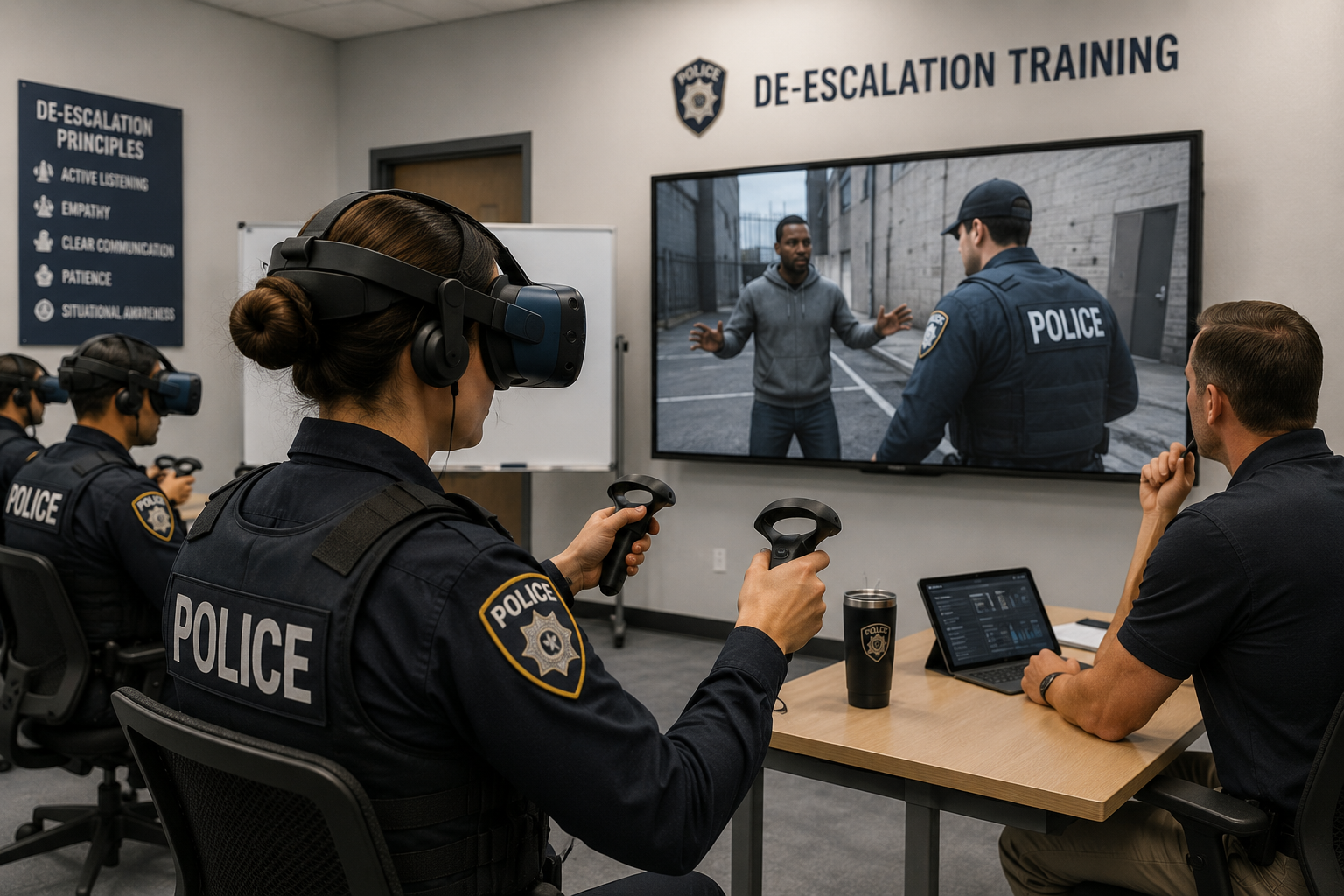
Not every police incident ends with an arrest or the use of force. In fact, many of the most successful interactions between officers and members of the public are resolved through effective communication, patience and sound judgement. De-escalation has become an increasingly important aspect of modern policing because it helps officers reduce tension, encourage cooperation and bring potentially volatile situations under control while minimising risk for everyone involved. Developing these skills requires more than classroom discussion alone. Officers need opportunities to practise communicating with people experiencing stress, fear, confusion or aggression in environments that feel realistic without exposing anyone to unnecessary danger. This is where VR training for law enforcement is making a significant impact. By recreating lifelike scenarios in a controlled setting, virtual reality allows officers to build confidence and refine their de-escalation techniques through repeated practice and constructive feedback.
Every Conversation Can Influence the Outcome
Many incidents are shaped by the way an interaction begins.
The tone of an officer’s voice, the language they use and the amount of time they allow someone to respond can all influence how a situation develops. A calm and respectful approach may reduce tension, while poor communication has the potential to increase frustration or fear.
Virtual reality scenarios allow officers to experience these interactions firsthand. Instead of reading about communication strategies, participants actively engage with virtual individuals whose behaviour changes in response to the officer’s decisions.
This dynamic environment demonstrates how different approaches can lead to very different outcomes.
Practising Difficult Situations Safely
Some of the most challenging incidents involve individuals experiencing mental health crises, emotional distress or severe anxiety.
These situations require officers to balance empathy with public safety while making decisions under pressure. Recreating these incidents in the real world can be difficult, expensive and potentially unsafe.
Virtual reality provides a practical alternative by allowing officers to experience similar situations without placing participants or role players at risk. Scenarios can be repeated as often as necessary, giving trainees the opportunity to experiment with different communication techniques and learn from each experience.
Building Confidence Through Repetition
Like any professional skill, de-escalation improves with practice.
Traditional role-play exercises are valuable, but they often depend on the availability of instructors, actors and suitable training facilities. Virtual reality makes it easier to revisit scenarios regularly, helping officers reinforce effective behaviours over time.
Repeated exposure to different situations encourages officers to remain calm when faced with uncertainty. Rather than reacting impulsively, they learn to assess the circumstances, consider available options and respond with greater confidence.
This consistency helps turn good communication habits into natural responses during real incidents.
Learning That Every Situation Is Different
No two encounters unfold in exactly the same way.
An individual who appears angry may actually be frightened. Someone who seems uncooperative may simply be confused or struggling to understand instructions. Effective de-escalation requires officers to assess behaviour carefully rather than relying on assumptions.
Virtual reality training reflects this unpredictability by presenting a wide range of scenarios with different personalities, environments and outcomes. Participants quickly discover that the same communication style will not always produce the same result.
This flexibility encourages officers to adapt their approach according to the specific circumstances they face.
Immediate Feedback Encourages Improvement
One of the greatest strengths of immersive training is the opportunity to review performance immediately after a scenario has ended.
Instructors can discuss communication choices, body positioning, timing and overall decision-making while events remain fresh in the participant’s mind. Officers are encouraged to reflect on what worked well and where alternative approaches may have achieved a better outcome.
Because scenarios can be repeated, trainees have the opportunity to apply that feedback straight away, reinforcing learning through practical experience rather than theory alone.
Balancing Communication and Officer Safety
De-escalation does not mean ignoring potential threats.
Officers must remain aware of their surroundings, maintain appropriate positioning and continue assessing risk throughout every interaction. Successful communication and sound tactical awareness work together rather than competing with one another.
Virtual reality allows these elements to be practised simultaneously. Officers learn to communicate effectively while remaining alert to changes in behaviour, environmental hazards or emerging risks.
This integrated approach reflects the complexity of real policing more accurately than isolated classroom exercises.
Supporting Ongoing Professional Development
Communication skills require continuous development throughout an officer’s career.
As policing evolves and communities change, agencies need flexible training methods that can be updated to reflect new operational challenges. Virtual reality platforms make it possible to introduce new scenarios, incorporate revised procedures and revisit existing exercises without organising large-scale practical events.
This allows officers to continue strengthening their de-escalation skills long after their initial training has been completed.
Preparing Officers for Real-World Encounters
Every interaction between law enforcement and the public has the potential to influence trust, confidence and community relationships. Equipping officers with strong de-escalation skills benefits not only individual encounters but also broader policing outcomes.
VR training for law enforcement provides a realistic environment where officers can practise communication, decision-making and conflict resolution without the consequences associated with real incidents. Through repeated exposure to challenging scenarios, immediate feedback and opportunities for continuous improvement, virtual reality helps officers develop the confidence and judgement needed to reduce tension, resolve conflicts more effectively and respond professionally when faced with some of the most demanding situations in modern policing.